EIGENN.
docsguidesapichangelogpricingsign in
EIGENN.

Use transaction categories as actuals

Link the monthly net of a transaction category to a variable in a monthly model.

A Bank transactions source or a CSV import source gives the net amount of each transaction category for each month. You can link one category to one variable. The variable then shows the category's monthly net in its actual periods.

Use category actuals when your bank activity is the best record of a revenue or cost line, such as rent, payroll, or software spend.

What the source contains

  • One value for each category and calendar month. The transaction date sets the month.
  • Signed amounts: income is positive and spend is negative.
  • Amounts in the team's base currency. Eigenn leaves out a foreign-currency transaction that has no converted base amount.
  • Only transactions with the status posted or completed.
  • No internal transfers, and no categories that are marked as excluded.
  • Transactions without a category go to Uncategorized.

A parent category and each of its child categories are separate items. The parent item includes only the transactions that have the parent category itself.

Monthly models only

The source has one record for each month. Eigenn attaches category actuals only to a model with monthly periods. In a model with other periods, the panel shows: "Transaction-category actuals land monthly, but this model uses quarter periods. Use a monthly model."

To change the periods, select Model settings and set Granularity to Monthly. Then select Apply changes.

Link a category

  1. In the model, select Model settings → Data sources.
  2. In the Transaction categories section, choose the source.
  3. Choose the category.
  4. Choose the variable.
  5. Select Attach category actuals.

If the section has no source, select Add category source. The section shows "Transaction category source queued for its first refresh." Wait until the source is Active, then attach the category.

An excluded category shows "(excluded from analytics)" in the list. You cannot select it.
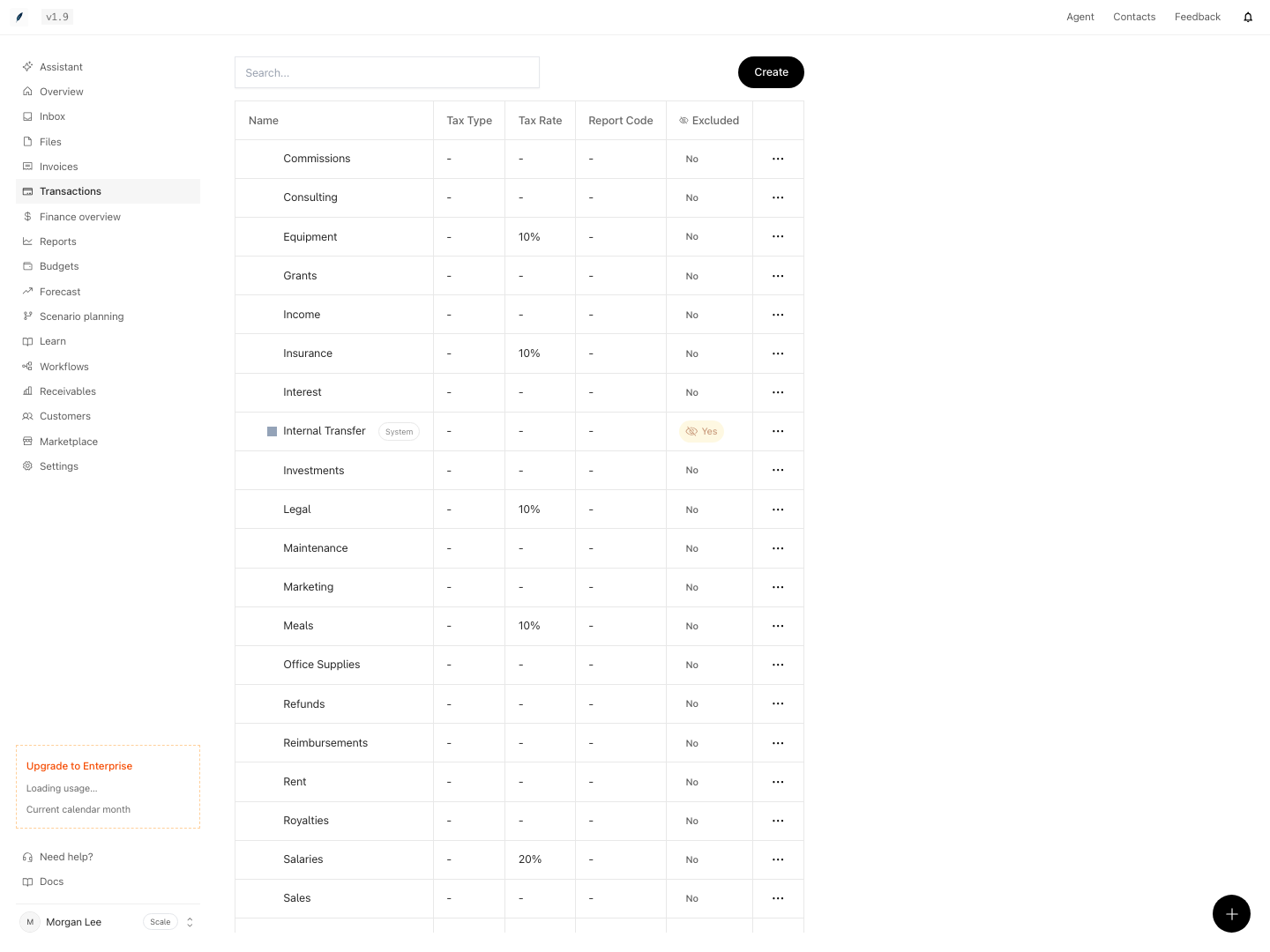
The Transactions categories table with the Name, Tax Type, Tax Rate, Report Code, and Excluded columns. Internal Transfer has a System badge and shows Excluded as Yes. The other categories show No.

Keep the sign in the forecast

A spend category gives negative actuals. Keep the forecast periods in the same sign, so that totals and charts stay correct. For example, a Rent variable can carry the last actual forward:

Rent[previous]

If another formula needs the cost as a positive number, write -Rent in that formula.

Related

  • Link a variable to data
  • Connect a data source
  • Granularity
  • Refresh and check actuals
  • Dimensions concept
  • Transaction Categories and Rules

Use a variable from another model

Link another planning model, then read its variables in formulas as Model.Variable references.

Values with uncertainty

Write a range or a distribution in a formula, then run a simulation to read the P10, P50, and P90 results.

On this page

What the source containsMonthly models onlyLink a categoryKeep the sign in the forecastRelated

Eigenn docs

current product

Overview
Overview
OverviewAccount PreferencesApproval PoliciesAssistant AutomationAssistant Command CenterAssistant Workspace and Saved WorkBank ConnectionsBilling and UsageBudgets and ForecastCommand CenterCustomer FieldsCustomer LifecycleCustomer RecordsCustomersDeveloper PlatformDocument Processing and ExtractionFiles and Document VaultFinancial Analytics and ReportsFinancial OverviewInbox and ApprovalsInvoice InsightsInvoice ProductsInvoicesMarketplace IntegrationsNotifications and BrandingOnboarding and SupportOverviewPlanning Data and DimensionsPlanning Models and FormulasPlanning Time and ActualsPlanning UncertaintyPlanning Versions and CollaborationPlanning Views and ExportsPlans and AdjustmentsReceivablesReceivables AnalyticsReceivables ControlsRolling Budget CloseScenario PlanningSecurity and AccessSettings OverviewStress TestsTeams and OrganizationsTone Profiles and ExperimentsTransaction Categories and RulesTransaction CodingTransactionsWeekly Finance RitualWorkflow ExecutionsWorkflow OutcomesWorkflow PausesWorkflows
OverviewBudget vs. ActualsBuild a Driver-Based Planning ModelBuild and Review a ForecastBuild Your First WorkflowCollaborate on a Planning ModelCompare and Share Planning ScenariosConfigure Approval PoliciesConfigure Assistant OperationsConfigure Customer FieldsConfigure Notifications and BrandingConfigure Planning Time and ActualsConfigure Receivables ControlsConnect Planning Data and ActualsConnect Transaction RecordsConsolidationCreate and Manage CustomersCreate and Send InvoicesCreate Your First Planning ModelDeveloper API SetupFirst Cash ReviewHeadcount PlanningInvoice Collection WorkflowMaintain Transaction RulesManage Security and BillingManage Team AccessManage the Invoice LifecycleMCP WorkflowsMonitor and Recover WorkflowsOrganize and Share DocumentsProcess Inbox ItemsReconcile and Categorize TransactionsRevenue ForecastingReview a Customer Finance RecordReview, Restore, and Export a Planning ModelRun a Finance Operating ReviewRun a Receivables Tone ExperimentRun a Runway Stress TestRun Planning Uncertainty AnalysisRun Your First Command Center ReviewSave and Share Assistant WorkSet Up a WorkspaceTroubleshoot Account AccessWebhook DeliveryWeekly CFO Review
Overview

Concepts

DataDimensionsFormulasScenarios

Variables

VariablesChange an input over timeCreate a variableFormat a variableOrganize variablesTime totalsUse a variable from another modelVariable types

Time

TimeLast actual dateRoll the model forwardTime granularityTime settings

Formulas

FormulasBlanks and helpersCommon formulas: cash and balance sheetCommon formulas: cohortsCommon formulas: currency and multiple entitiesCommon formulas: headcount and payrollCommon formulas: SaaS metricsCommon formulas: seasonalityConditionalsDimension referencesFormula syntaxFunctionsTime referencesTroubleshoot formulasValues with uncertaintyWrite a formula

Charts and Dashboards

Charts and dashboardsCompare scenarios and versionsCreate a chartExport and shareTablesTime aggregation in charts

Dimensions

DimensionsApply a dimensionCreate a dimensionDimension examplesDimension totalsThe Dimensions page

Data

DataChoose cash or accrual for XeroConnect a data sourceLink a variable to dataRefresh and check actualsUse transaction categories as actuals

Data Integrations

Data integrationsBank transactionsCSV importFortnoxQuickBooksStripeXero

Views

ViewsCreate and edit a viewFilter a viewShare a view

Versions

VersionsCompare versionsRestore a versionSave a version

Scenarios

ScenariosCompare scenariosCreate a scenarioPlans and adjustmentsStress tests and shocks

Collaboration

CollaborationComment on a modelShare a model and set accessTeam roles and planning access

Managing Models

Managing modelsDuplicate a modelExport a modelModel limits and performanceStart from a templateThe models home and foldersTrash, restore, and delete a model
OverviewIntegrationsMCPSDKsWebhooks
OverviewAuthenticationBank Accounts APICustomers APIErrorsForecasts and Stress Tests APIInvoice Payments APIInvoices APIPaginationRate LimitsRemote Tracker API StatusTracker Categories APITracker Entries and Timers APITracker Projects APITransactions APIWebhooks API StatusWorkflows API
Overview
Overview