EIGENN.
docsguidesapichangelogpricingsign in
EIGENN.

Start from a template

Create a planning model from a blank grid or from one of the built-in templates.

A template creates a model that already has sections, variables, formulas, and example inputs. Use New model to build the structure yourself.

Templates do not need a connected integration. Replace the example inputs with your own numbers.

1. Open the template list

Go to Scenario planning → click New model. You can also click the Quick start card.

The Create model dialog opens. The right side shows a preview of the highlighted row.
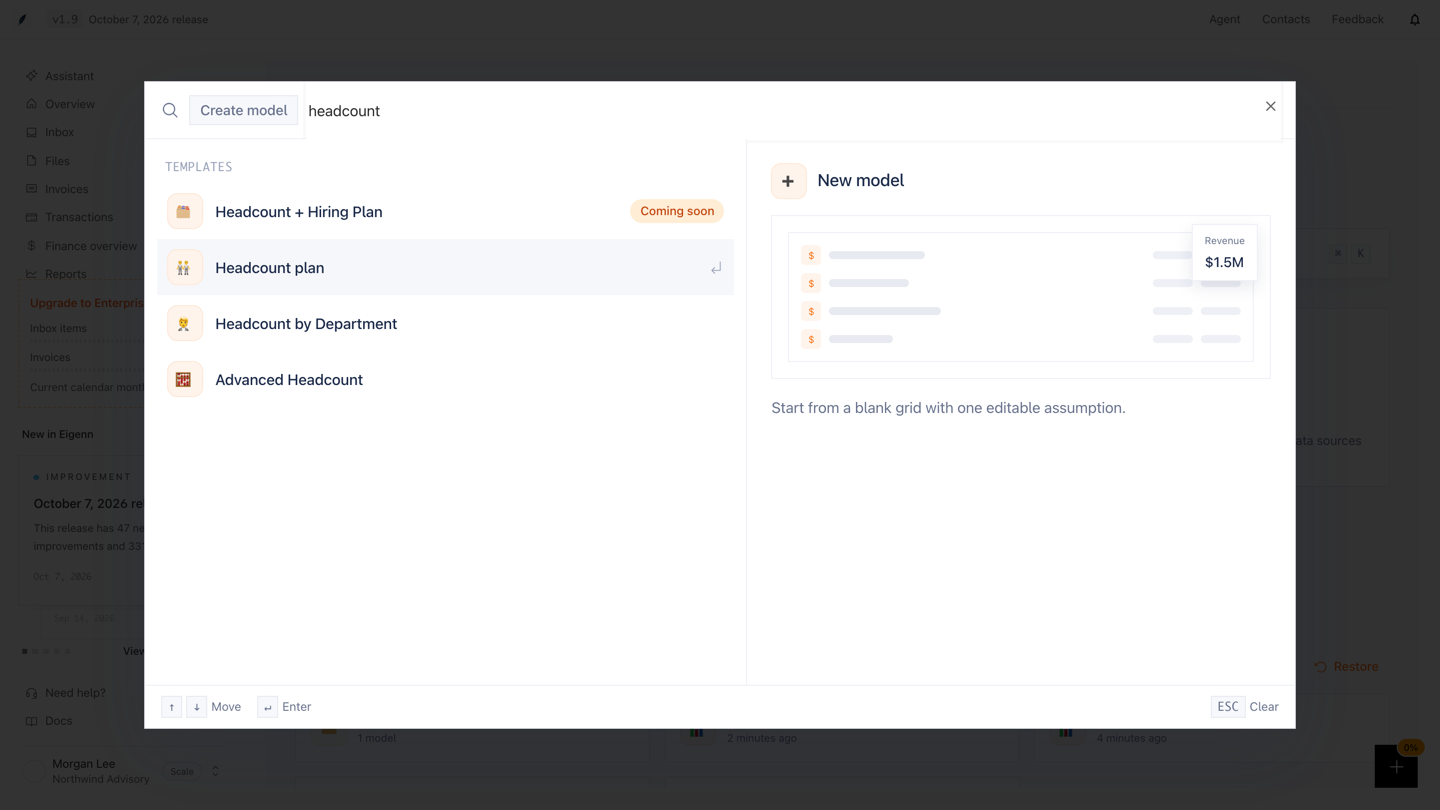
The Create model window with headcount in the search box. Templates lists Headcount + Hiring Plan marked Coming soon, then Headcount plan, Headcount by Department, and Advanced Headcount.

2. Create the model

  1. Type in the Search… field to filter the rows.
  2. Point to a row, or use ↑ and ↓, to see its preview.
  3. Click the row, or press ↵.

Eigenn creates the model and opens it. The model gets the template name. A blank model gets the name New model. Only a workspace Owner can create a model.

What a new model contains

  • New model has an Inputs section with one Assumption input, and an empty Calculations section.
  • Each new model has 12 monthly periods. The first period is the current month.
  • 13-Week Cash Flow has 13 weekly periods. The first period is the current week.

The dialog shows all templates under Templates. The topic groups below are on this page only.

Financial statements and cash

  • Three Statement Model: a P&L, a simple balance sheet, and a cash roll-forward.
  • P&L and Runway: burn against cash, and the runway in months.
  • Balance Sheet & Cashflow: retained earnings and cash, with a working-capital adjustment.
  • 13-Week Cash Flow: weekly inflows, outflows, cash balance, and weeks of cover.
  • Receivables & DSO: collections, receivables, and days sales outstanding.
  • Late Fee & Interest Income: interest and late-fee income on overdue balances.
  • SaaS Working Capital Template: collections, prepaid amounts, and payables for a SaaS company.
  • Budget vs Actuals Variance: budget against actuals, with revenue attainment and cost overrun.

Revenue and customers

  • B2B SaaS Revenue Model: a driver-based recurring revenue model.
  • SaaS Metrics: MRR movement, NRR, CAC, churn, and burn efficiency.
  • Seasonal Revenue: higher revenue in peak months and lower revenue in the other months.
  • Simple Cohort Model: a customer base that retention drives, with revenue per customer.
  • Advanced Cohort: cohort retention for each acquisition channel.

Headcount, costs, and consolidation

  • Headcount plan: monthly hires and the payroll cost.
  • Headcount by Department: headcount and fully loaded payroll for each department.
  • Advanced Headcount: one row for each employee, with raises and bonuses.
  • Costs by Vendor: costs for each vendor, compared with the budget.
  • Consolidation by Entity: several entities, with intercompany eliminations.
  • Multi-currency Consolidation: entities in different currencies, with one FX rate for each entity.

Stress tests

  • Cash Flow Stress Test: how far revenue can fall before you burn cash.
  • SaaS Churn Stress: higher churn, and its effect on MRR, ARR, and retention.
  • Cost Inflation Stress: higher costs, and the effect on margins and break-even.
  • Collections Delay Stress: slower collections, and the cash gap against receivables.
  • Demand Shock Model: a change in units or price, with contribution margin and break-even volume.
  • Interest Rate Stress: a higher interest rate, and interest coverage against EBITDA.
  • FX Exposure Stress: a change in the FX rate, and foreign revenue and profit in your base currency.
  • Customer Concentration Stress: the loss of your top customer, and the revenue that you can absorb.

Rows with a Coming soon badge are not available. You cannot select them.

Related

  • Managing models
  • Revenue Forecasting
  • Headcount Planning
  • Stress and shocks

Share a view

Give a teammate view or edit access to one saved view, copy its link, and check what the teammate sees.

Stress tests and shocks

Apply a percent, amount, or fixed-value shock to many forecast cells of a scenario, and read where a cash row first goes negative.

On this page

1. Open the template list2. Create the modelWhat a new model containsFinancial statements and cashRevenue and customersHeadcount, costs, and consolidationStress testsRelated

Eigenn docs

current product

Overview
Overview
OverviewAccount PreferencesApproval PoliciesAssistant AutomationAssistant Command CenterAssistant Workspace and Saved WorkBank ConnectionsBilling and UsageBudgets and ForecastCommand CenterCustomer FieldsCustomer LifecycleCustomer RecordsCustomersDeveloper PlatformDocument Processing and ExtractionFiles and Document VaultFinancial Analytics and ReportsFinancial OverviewInbox and ApprovalsInvoice InsightsInvoice ProductsInvoicesMarketplace IntegrationsNotifications and BrandingOnboarding and SupportOverviewPlanning Data and DimensionsPlanning Models and FormulasPlanning Time and ActualsPlanning UncertaintyPlanning Versions and CollaborationPlanning Views and ExportsPlans and AdjustmentsReceivablesReceivables AnalyticsReceivables ControlsRolling Budget CloseScenario PlanningSecurity and AccessSettings OverviewStress TestsTeams and OrganizationsTone Profiles and ExperimentsTransaction Categories and RulesTransaction CodingTransactionsWeekly Finance RitualWorkflow ExecutionsWorkflow OutcomesWorkflow PausesWorkflows
OverviewBudget vs. ActualsBuild a Driver-Based Planning ModelBuild and Review a ForecastBuild Your First WorkflowCollaborate on a Planning ModelCompare and Share Planning ScenariosConfigure Approval PoliciesConfigure Assistant OperationsConfigure Customer FieldsConfigure Notifications and BrandingConfigure Planning Time and ActualsConfigure Receivables ControlsConnect Planning Data and ActualsConnect Transaction RecordsConsolidationCreate and Manage CustomersCreate and Send InvoicesCreate Your First Planning ModelDeveloper API SetupFirst Cash ReviewHeadcount PlanningInvoice Collection WorkflowMaintain Transaction RulesManage Security and BillingManage Team AccessManage the Invoice LifecycleMCP WorkflowsMonitor and Recover WorkflowsOrganize and Share DocumentsProcess Inbox ItemsReconcile and Categorize TransactionsRevenue ForecastingReview a Customer Finance RecordReview, Restore, and Export a Planning ModelRun a Finance Operating ReviewRun a Receivables Tone ExperimentRun a Runway Stress TestRun Planning Uncertainty AnalysisRun Your First Command Center ReviewSave and Share Assistant WorkSet Up a WorkspaceTroubleshoot Account AccessWebhook DeliveryWeekly CFO Review
Overview

Concepts

DataDimensionsFormulasScenarios

Variables

VariablesChange an input over timeCreate a variableFormat a variableOrganize variablesTime totalsUse a variable from another modelVariable types

Time

TimeLast actual dateRoll the model forwardTime granularityTime settings

Formulas

FormulasBlanks and helpersCommon formulas: cash and balance sheetCommon formulas: cohortsCommon formulas: currency and multiple entitiesCommon formulas: headcount and payrollCommon formulas: SaaS metricsCommon formulas: seasonalityConditionalsDimension referencesFormula syntaxFunctionsTime referencesTroubleshoot formulasValues with uncertaintyWrite a formula

Charts and Dashboards

Charts and dashboardsCompare scenarios and versionsCreate a chartExport and shareTablesTime aggregation in charts

Dimensions

DimensionsApply a dimensionCreate a dimensionDimension examplesDimension totalsThe Dimensions page

Data

DataChoose cash or accrual for XeroConnect a data sourceLink a variable to dataRefresh and check actualsUse transaction categories as actuals

Data Integrations

Data integrationsBank transactionsCSV importFortnoxQuickBooksStripeXero

Views

ViewsCreate and edit a viewFilter a viewShare a view

Versions

VersionsCompare versionsRestore a versionSave a version

Scenarios

ScenariosCompare scenariosCreate a scenarioPlans and adjustmentsStress tests and shocks

Collaboration

CollaborationComment on a modelShare a model and set accessTeam roles and planning access

Managing Models

Managing modelsDuplicate a modelExport a modelModel limits and performanceStart from a templateThe models home and foldersTrash, restore, and delete a model
OverviewIntegrationsMCPSDKsWebhooks
OverviewAuthenticationBank Accounts APICustomers APIErrorsForecasts and Stress Tests APIInvoice Payments APIInvoices APIPaginationRate LimitsRemote Tracker API StatusTracker Categories APITracker Entries and Timers APITracker Projects APITransactions APIWebhooks API StatusWorkflows API
Overview
Overview