EIGENN.
docsguidesapichangelogpricingsign in
EIGENN.

Scenarios

Test alternative cases inside one planning model with scenarios, shocks, and plans, and keep the base case unchanged.

A scenario is an alternative case inside a planning model. It keeps the base case and stores only the inputs that you change. These stored inputs are overrides. Use a scenario when you want to ask "what if" without a copy of the model.

Every scenario uses the same rows and formulas as the base. Eigenn calculates each scenario from the base values and the scenario overrides. Thus a difference between two scenarios comes only from their overrides. When you change the base, each scenario follows that change, except in the cells that the scenario overrides.

The Scenarios menu marks the base scenario Default. Each other scenario shows its number of overrides, for example 3 overrides. Only a team Owner opens the full model, so only an Owner creates, compares, shocks, or promotes scenarios. Other teammates see a scenario through a saved view that an Owner shares.
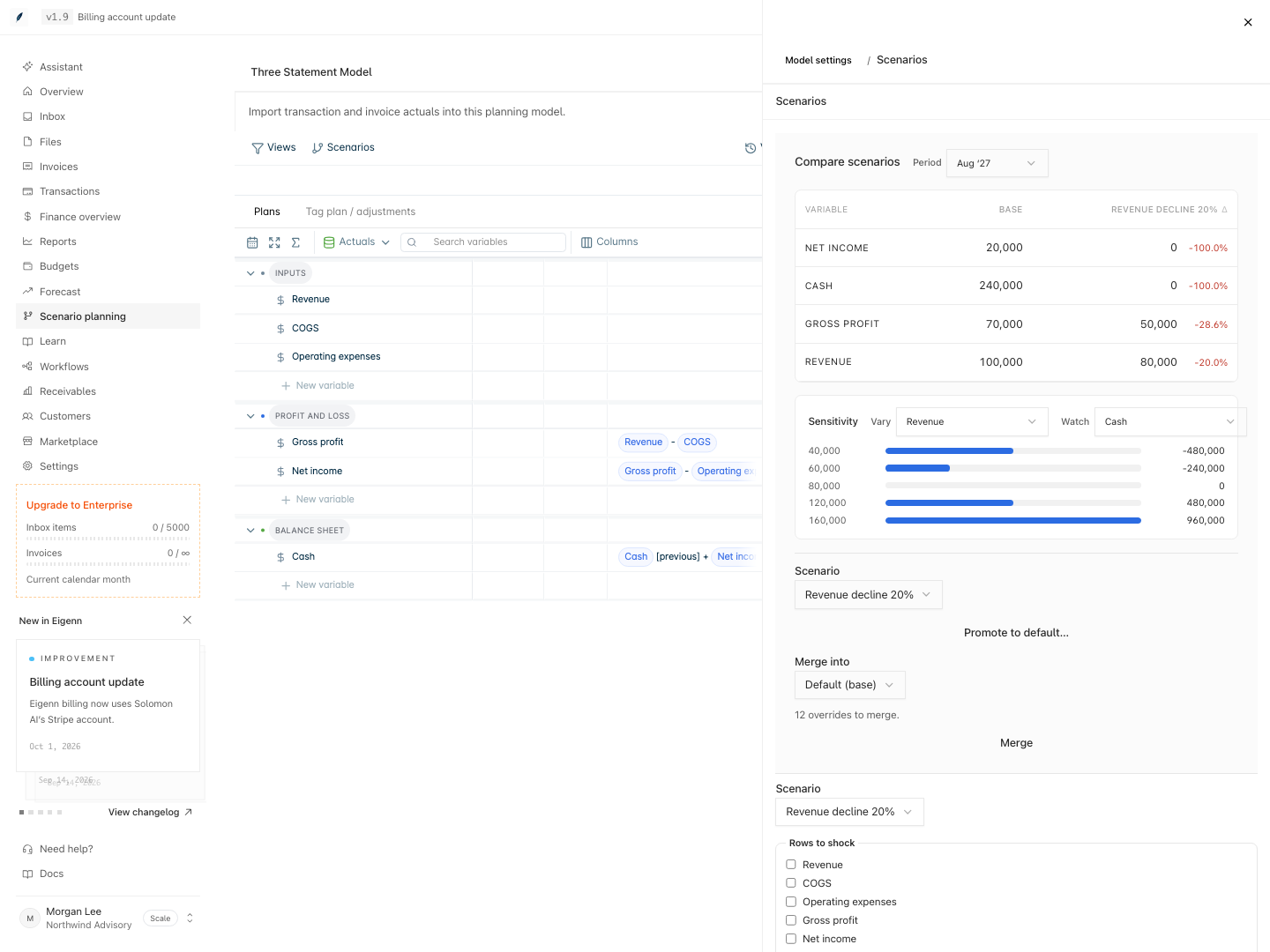
The Model settings Scenarios panel for a Three Statement Model. Compare scenarios shows Base and Revenue decline 20% for Aug '27, and the stress controls start below.

Pages in this group

  • Create a scenario: add a scenario from the Scenarios menu, then enter overrides in the grid.
  • Compare scenarios: read the changed rows side by side in Model settings, and see scenario lines in charts.
  • Stress tests and shocks: change many forecast cells of a scenario in one step with a percent, amount, or fixed-value shock.
  • Plans and adjustments: tag scenario changes with named initiatives and show their direct effect on a timeline.

Scenarios, versions, and saved views

These three tools do different jobs:

ToolWhat it keepsUse it to
ScenarioLive overrides on the current modelCompare alternative cases now
VersionA frozen copy of the whole model, with all scenariosReturn to the model as it was on a past date
Saved viewA filter on rows, periods, and scenariosShow a focused slice to a reader

A scenario in a planning model is separate from a saved scenario in Forecast. The two do not update each other.

Related

  • Scenarios concept
  • Save a version
  • Compare scenarios and versions in charts
  • Compare and share planning scenarios
  • Views

Scenarios

A scenario changes selected inputs of a model without rewriting the base case, so you can compare and stress alternatives in one grid.

Share a model and set access

Share a saved view of a planning model with a teammate as Can view or Can edit within view, preview the result, and copy the link.

On this page

Pages in this groupScenarios, versions, and saved viewsRelated

Eigenn docs

current product

Overview
Overview
OverviewAccount PreferencesApproval PoliciesAssistant AutomationAssistant Command CenterAssistant Workspace and Saved WorkBank ConnectionsBilling and UsageBudgets and ForecastCommand CenterCustomer FieldsCustomer LifecycleCustomer RecordsCustomersDeveloper PlatformDocument Processing and ExtractionFiles and Document VaultFinancial Analytics and ReportsFinancial OverviewInbox and ApprovalsInvoice InsightsInvoice ProductsInvoicesMarketplace IntegrationsNotifications and BrandingOnboarding and SupportOverviewPlanning Data and DimensionsPlanning Models and FormulasPlanning Time and ActualsPlanning UncertaintyPlanning Versions and CollaborationPlanning Views and ExportsPlans and AdjustmentsReceivablesReceivables AnalyticsReceivables ControlsRolling Budget CloseScenario PlanningSecurity and AccessSettings OverviewStress TestsTeams and OrganizationsTone Profiles and ExperimentsTransaction Categories and RulesTransaction CodingTransactionsWeekly Finance RitualWorkflow ExecutionsWorkflow OutcomesWorkflow PausesWorkflows
OverviewBudget vs. ActualsBuild a Driver-Based Planning ModelBuild and Review a ForecastBuild Your First WorkflowCollaborate on a Planning ModelCompare and Share Planning ScenariosConfigure Approval PoliciesConfigure Assistant OperationsConfigure Customer FieldsConfigure Notifications and BrandingConfigure Planning Time and ActualsConfigure Receivables ControlsConnect Planning Data and ActualsConnect Transaction RecordsConsolidationCreate and Manage CustomersCreate and Send InvoicesCreate Your First Planning ModelDeveloper API SetupFirst Cash ReviewHeadcount PlanningInvoice Collection WorkflowMaintain Transaction RulesManage Security and BillingManage Team AccessManage the Invoice LifecycleMCP WorkflowsMonitor and Recover WorkflowsOrganize and Share DocumentsProcess Inbox ItemsReconcile and Categorize TransactionsRevenue ForecastingReview a Customer Finance RecordReview, Restore, and Export a Planning ModelRun a Finance Operating ReviewRun a Receivables Tone ExperimentRun a Runway Stress TestRun Planning Uncertainty AnalysisRun Your First Command Center ReviewSave and Share Assistant WorkSet Up a WorkspaceTroubleshoot Account AccessWebhook DeliveryWeekly CFO Review
Overview

Concepts

DataDimensionsFormulasScenarios

Variables

VariablesChange an input over timeCreate a variableFormat a variableOrganize variablesTime totalsUse a variable from another modelVariable types

Time

TimeLast actual dateRoll the model forwardTime granularityTime settings

Formulas

FormulasBlanks and helpersCommon formulas: cash and balance sheetCommon formulas: cohortsCommon formulas: currency and multiple entitiesCommon formulas: headcount and payrollCommon formulas: SaaS metricsCommon formulas: seasonalityConditionalsDimension referencesFormula syntaxFunctionsTime referencesTroubleshoot formulasValues with uncertaintyWrite a formula

Charts and Dashboards

Charts and dashboardsCompare scenarios and versionsCreate a chartExport and shareTablesTime aggregation in charts

Dimensions

DimensionsApply a dimensionCreate a dimensionDimension examplesDimension totalsThe Dimensions page

Data

DataChoose cash or accrual for XeroConnect a data sourceLink a variable to dataRefresh and check actualsUse transaction categories as actuals

Data Integrations

Data integrationsBank transactionsCSV importFortnoxQuickBooksStripeXero

Views

ViewsCreate and edit a viewFilter a viewShare a view

Versions

VersionsCompare versionsRestore a versionSave a version

Scenarios

ScenariosCompare scenariosCreate a scenarioPlans and adjustmentsStress tests and shocks

Collaboration

CollaborationComment on a modelShare a model and set accessTeam roles and planning access

Managing Models

Managing modelsDuplicate a modelExport a modelModel limits and performanceStart from a templateThe models home and foldersTrash, restore, and delete a model
OverviewIntegrationsMCPSDKsWebhooks
OverviewAuthenticationBank Accounts APICustomers APIErrorsForecasts and Stress Tests APIInvoice Payments APIInvoices APIPaginationRate LimitsRemote Tracker API StatusTracker Categories APITracker Entries and Timers APITracker Projects APITransactions APIWebhooks API StatusWorkflows API
Overview
Overview